

The AI Literacy Shift
The Government Just Defined AI Literacy. Here's What That Means for You.

I scroll on LinkedIn, seeing your new jobs, up-skills, and posts about your kids. I can enjoy those mostly with neutrality until someone posts about artificial intelligence and how they are using it in their work. Then the emotions and questions creep in. What are they doing with it? Have I heard of that? Do I know how to do that, too?
Small trickles of anxiety and fear about falling behind start to fill my head. Many people have spoken about this noise in the artificial intelligence world. I have set up my workflow to reduce that overwhelming state. I’ve also previously shared how professionals have entrusted me with similar concerns. Maybe I need to scroll less. My justification is the connections I’ve made.
The News Translated
On Friday, February 13, 2026, the Department of Labor released TEN 07-25 and shared it with state workforce agencies, employers, community colleges, etc. Included was a “road map” for artificial intelligence literacy. Their framework is the first time AI literacy has been defined at the federal level. It included a defined set of competencies that guide how to use and evaluate AI technologies responsibly. There are 5 foundational content areas and 7 effective delivery principles.
This establishes a baseline for every worker. Not just the tech-loving guy in the cubicle down the hall or the new batch of young interns. That just gave me a flashback to being the youngest in the office and expected to know everything about computers. It was unreasonable in the early 00’s, and it is now in 2026.
What is it NOT? A mandate. Although I have learned in my career that the money follows those who play nice. So if you work with the government in any capacity or apply for grants, alignment with this framework may be of particular importance to you. So let’s take a look at what’s in it.
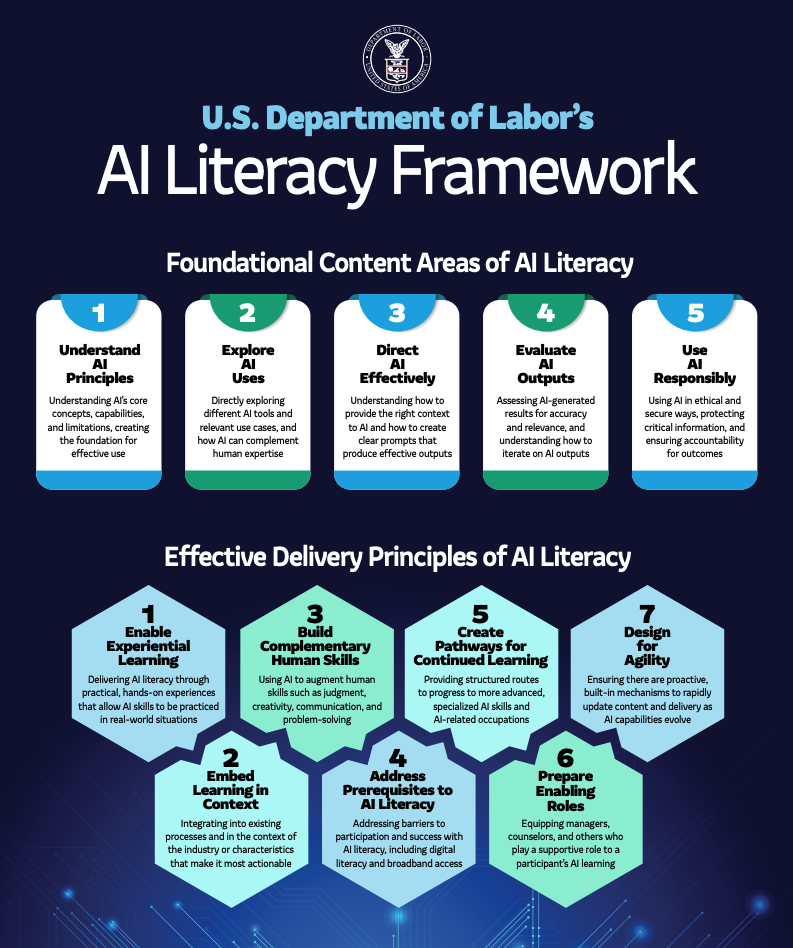
Source: U.S. Department of Labor AI Literacy Framework, TEN 07-25, February 2026. Full document linked above.
What the DOL Actually Said
The framework includes two distinct parts: Foundational Content Areas of AI Literacy and Effective Delivery Principles of AI Literacy. Most of the conversations I see about AI learning are about what to learn. This framework is organized into two layers, and honestly, the second one is where it gets interesting.
The 5 content areas are key learnings. As someone who instructs AI literacy, it often surprises me how much time I could spend on what artificial intelligence actually is. I use examples to support understanding, and depending on the audience's age, use different references to older technology. I guess it’s the history teacher in me.
One of my favorites is asking if they remember those pictures they showed us in grade school of a computer taking up a whole room. Then I remind them how powerful the “computer” known as their cell phone is and how constant technological change will continue to be.

Source: John von Neumann with the IAS Computer, The Computer History Museum
Understanding how something works, I believe, helps you use it better. The other content areas also make sense, such as exploring tools for use, prompting, evaluation, and use responsibly. The document also outlines clear directions for what more specific areas to focus on. For example, AI use cases include productivity tools, information support, creative assistance, task-specific applications, and decision support systems.
The more interesting part of the framework is the delivery principles. This speaks directly to how people grow and learn. It puts the human in the center of the learning content. Translating frameworks into practical, actionable steps is what I have spent the past 17 years doing. It’s the conversation I’ve been waiting to have.
Why This Validates What You Have Already Felt
The state of overwhelm we are in makes sense. We are only working with so much working memory in our brains. You want a healthy balance of not offloading cognitive load but also not overwhelming it. With the amount of information we receive daily, who wouldn’t be overwhelmed?
The conversation specifically happening with AI has focused on tools and outputs. I refer to it as “shiny object syndrome”. Ooh, look at the fancy new tool and what it does! But how is that actually supporting your workflow?
Your humanity is your capital, and the DOL just stood behind you. Learning how to use AI in your professional context and the tools should amplify your skills, knowledge, and judgment. I often refer to it as your “special sauce” or “voice”. The thing that only you can provide based on your talents, profession, and life experience.
This connection between human skills and effective learning is not new to me. Designing engaging and meaningful learning experiences has been the core of my career. My doctoral research hinged on the work of Dr. Fredricka Reisman, Professor Emeritus and Director of the Translational Research Center for Creativity and Motivation at Drexel University.
Her Reisman Diagnostic Creativity Assessment (RDCA) identifies specific human skills, like flexibility and creative thinking, that can be measured and strengthened just like a muscle. These skills are similar to what the DOL just built a framework around. We'll go deeper on that connection as the series unfolds, because it changes how you think about what AI literacy actually requires of you.
Why This Series Exists
In this series, I will make this framework useful. When I saw it the first time, I thought this is what everyday professionals deserve. What’s next? Three more posts this month. Each one clusters delivery principles and connects them to how we can use AI for work and growth.
Series Preview:
Post 2: Start Where You Are, Not Where the Training Assumes You Are
Post 3: The Skills You Already Have Are the Ones AI Needs Most
Post 4: How to Stay Current Without Starting Over Every Six Months
Share this with a professional who's been told to learn AI but hasn't been told how. That's exactly who this series is for.
I feel the same fear, especially as an early career professional . I feel as though i have to master everything and be on my feet always. LinkedIn scares me because everyday someone talks about something you dont know and you need to learn. Thank you for this series!!!🥰🥰🥰
Great article! I love how everything is shifting to focus on AIs core focus being human centered.